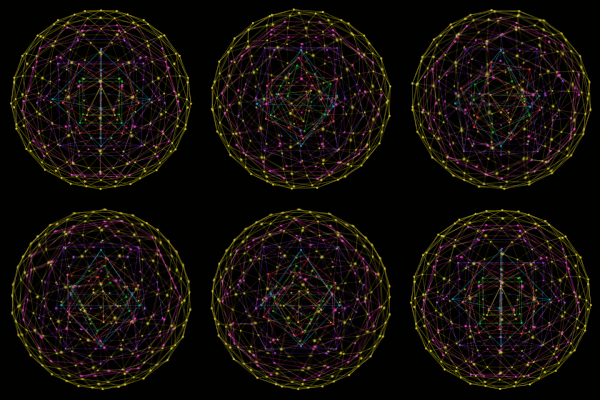
Agora and Necropolis
Pseudographic Dispatch from Society 317
Well, when we get communism it'll all be fucking great.
It will come soon, we just have to wait.
Everything will be free there, everything will be an upper.
We'll probably not even have to die.
I woke up in the middle of the night and realized,
That everything is going according to plan.
Everything is going according to plan.
- Yegor Letov
:ZONE_00:
(melanosis)
[[ GENEALOGY ]]
1917: The Most Sacred Conspiracy, Establishment of the Island of ASSU
2052: Government of Planet Earth, Establishment of Society 317
2059: Fall of Acropolis, Digging the Necropolis, Global New Economic Policy (G-NEP)
2066: Final Death of Velmir Klebnikov, Long Live the King of Time
2100: Second Construction of Babel, Tower to the Underworld
2155: Present
- Herodotus
The story begins in 2155. This is the date in the christian calendar, this calendar is made available to ground the reader in a sense of time, the world described does not inhabit 2155, there is no 2155. The story is set in an alternative future, one already set in motion by alternative pasts. This document contains testimony from a variety of perspectives, united by yours truly, the faceless historiography of Society 317.
Below is included a topographical map for the ease of understanding the following sections:
01 = Agora
02 = Necropolis
03 = Gaia
Entry 1: Arrival
I have awoken in a world unrecognizable to myself. I do not know the forces that took me here. But, what I have found here is uncanny and indistinguishable. It is as if those things in the world, once viewed so separate from one another, were swallowed up by a rampant pathogen into something total. It is nauseating. I take in what is around me. It hints at once being the metropolis Chicago. I see, in place of the sprawl I had been familiar with, something Autarkic. The ground is constantly changing shape. I see masses of biology and machine seamlessly moving about. Before me, is a man with an infinitude of wires spewing out of his form. The sight makes me sick. What once could be said to be man is no longer. I move closer and touch what I realized to be a mycological network stretched across the mass of man and wire. I widen my horizon and I see material shape into mountains, then sea, then the American street grid. I see deer glommed into electrical infrastructure and pipelines riddled with books. This place is silent, wordless. Or it is so total in sound that noise feels as though it has disappeared. Something so synthetic, so encompassing that it need not for a thing like speech... Any intersections, any ends, seem completely indistinct to me. Only I stand separate now...
:ZONE_01:
(leucosis)
[[ AGORA ]]
And so the gauntlet is thrown down
in these words: The Government of Planet Earth.
Ripped by red lightnings
the blue banner of unrule,
the banner of windswept dawns and morning suns,
is raised and waves across the face of earth.
Here it is, my friends!
The Government of Planet Earth.
- President-Chairman Velimir Klebnikov
The practice of the Agora is technomadism, Agora is anti-state-anti-corpus, Agora is Tehom, Agora is permanent Terra Nullius. Agora is the world as it is, the space which is inhabited in common, undivided by the violence of law and territory.
A human biofilm coats the Agora in marbled shifting population densities,
Expanding and contracting with the flow of migration and catastrophe,
In Agora there is no year,
no of,
no our,
no lord,
Agoran culture is given the merciful option of death,
New epochs, gods, new selves, in flux, the genealogy cannibalizes its conservatism,
In the Agora everything is good which has a good beginning,
For the Agora there is no end.
The onset of humanity was nomadic. The San (exonomic: the foragers) people live in intentionally temporal housing, consume only as much as was needed, and jetted their surplus upon over consumption. The San people live to this day, owing to the proficiency of their (non) economy; the world is built on the shoulders of their heroic deeds, their inhabited space in the land once called “a continent” and once called Afrika. Agoran life is the palingenesis of primitive communism; the foragers end of history; orthogenic replasticizing hypoincest.
The Agora is a patchwork of semipermanent semiresidential nodes, half abandoned Phalansteres. An autonomous self-repairing anthro-droid stacks coconuts on a triangular platform 57 miles from the equatorial line. Clay adobes wash and fold linens with plastic spider legs in advance of predicted migration patterns. The denizen of the Agora is in perpetual flight, their life is spent night by night in new Phalanstères, they move in groups or along, individuals become groups, groups scatter.
Empty halls bustle with migrants,
Life is encounter, dreamwalk, DC mini, espace, schizomemetic,
The Androgens of the Agora hyperspace dance headless in bliss,
Acephallus = transsexual dynamism.
Nomadism is that lifestyle which is most comfortable for the Agorans internal bio-systems, it is not their nature (as the Agorans insist they have none), only what they prefer. The prison as punishment is proof of this fact, all layers of alienated authority grow like arborous rings from the innermost point of total confinement.
Though the Phalanstères logistical networks may creep and mutate along the needs of Agoran technomadism, there exist more grounded landmarks, megaliths and megamachines. These landmarks are largely uninhabited save for a selective cast of Necropolitan priests, technomads who have sworn off their human urges towards novelty in the name of servicing and maintaining logistical hubs.
To the right is one such megastructure, located in westasia atop ruins of the city once called Paris. This structure serves primarily as a local databank engaging economic calculus for a large section of the continent; it is the largest Necropolitan access point in the region.
Though hundreds of miles in scale this megastructure only houses a few hundred people in a small central enclosure, most of the area is managed by anthro-droids and self-modifying surfaces.
Below are photographs taken in a largely abandoned Phalanstère near the settlement which the ancient regime of the American Empire called Kansas City. The following photographs were taken during periods of abandonment so as to not inconvenience any nomads or pilgrims who may be establishing seasonal homes in the structure.
These settlements are capable of automatic maintenance, renovating and remapping their interiors to fit changes in usage. Owing to hallucinations in the local computational circuits, Phalanstères which are left uninhabited for long periods of time tend towards more and more abstract renovations, as they lack the human input necessary to refine their architecture into practical forms.
To the Left is one such uninhabited Phalanstères operating in the suburbs of the central Slavian city once called Omsk. The hallucinations began slowly, expansive unlit subterranean cavities, large hollow towers lacking any internal infrastructure, redundant ledges and balconies, and so on. After some time however this Phalanstère began developing very strange features, most notably a subterranean cavity whose walls glow completely white, and another containing nothing but an enormous mirror.
Often these hallucinations gradually reinforce themselves, as the more unintuitive the structure becomes, the less likely it will be to be selected as a momentary shelter by the technomadic migrants.
These sites develop new double roles, becoming attractions for curiosity seekers and zealots convinced of deeper intention in these forms.
Entry 2: The Apartment
I had been wandering for some time. It is hard to say how long. My surroundings exist in a constant state of flux. I was getting tired. It was then that I stumbled upon a structure that rhymed with my idea of an apartment complex. The exterior was stone of sand and lime. It appeared as if the building was jetted out of the ground below it; like if the hand of a powerful, thinking, deity had pulled the stone from the earth below and sculpted it into something domicile. I reached out my hand, I touched it. Its surface was rough against my skin. You could see roots and networks of mushrooms grappled to the sides of the building. Its form was sharp, violent, completely brutal. I made it closer, seeking the rest I longed for.. I entered a triangular door and moved into the organic obelisk. I expected someone to be at a desk or residents to be wandering what appeared to be a common space at the bottom. What I found was disappointing. The common space of the complex was seemingly empty and like none I’d seen before. Hallways swirled in spirals, the open space had basic geometries spewing out from walls, ceilings and the floors, gargantuan house plants were growing and wrapping themselves around pillars and echoes of furniture. It felt as if the plants had grown in such a way as to pull all the other objects around them closer to itself. What I assume was meant to be furniture was constructed of sandstone and often was only parts of what we’d expect of them. I saw conglomerations of chairs and tables. These mobs of furniture looked more akin to bacteria, a virus, or abstract sculptures than any surface for human comfort. It was an ominous thought to think that someone like myself would’ve occupied such a perverted building. After taking in this schizophrenic picture of domesticity, I turned and looked at a different wall, when I looked back, the form of the building differed. I stumbled about for some time and repeatedly turned through the area. I found myself in an increasingly palatable common space with regular chairs and tables constructed of wood and cloth, a front desk (still made of sandstone but otherwise average in its form), and, in front of me, a mundane hallway that had pinstripe walls of cream and gold. I walked through this new hall. I entered a round door constructed of wood and painted green. Beyond the door, I found a space with similar dimensions to a typical studio apartment. Rest at last!
In rarer instances these areas become actively dangerous to habitation. In such instances it is protocol to sever these former Phalanstères from the greater Agoran network, as to not continue feeding a possibly dangerous entity. This severance has the effect of freezing the location in its terminal state, often these cites become no-go zones, with precautionary warnings a few miles out in all directions; all logistical lines in the area are also demolished. Below is an example of once such settlement, an unnamed former Phalanstère located in an undisclosed location in the southwestern desert of turtle island.
Fixed atop every known entrance to these hostile spaces are large sheets of pressed stainless steel, embossed in most known dialects the following passage:
This place is a message... and part of a system of messages... pay attention to it!
Sending this message was important to us. We considered ourselves to be a powerful culture.
This place is not a place of honor... no highly esteemed deed is commemorated here... nothing valued is here.
What is here is dangerous and repulsive to us. This message is a warning about danger.
The danger is in a particular location... it increases towards a center... the center of danger is here... of a particular size and shape, and below us.
The danger is still present, in your time, as it was in ours.
The danger is to the body, and it can kill.
The form of the danger is an emanation of energy.
The danger is unleashed only if you substantially disturb this place physically. This place is best shunned and left uninhabited.
While a majority of Phalanstères remain intermittently abandoned, certain areas can expect a consistent in residence population. Below are photographs taken in a more centralized settlement once called Dar es Salaam. This settlement is substantially larger and can expect to be at least 23% inhabited at any given time, due to this consistent habitation this settlement is fit with dedicated living quarters and communal spaces.
The building itself is an approximately 35 mile compound, consisting of semi subterranean dwellings connected via ladders to a large surface terrasse. Though complex the settlement is relatively invisible from ground level, resembling a series of mounds decorated by disorganized subsistence gardening.
Entry 3: The Tower
I have spent a hefty amount of time in this place now. I still don’t know how I came to be here nor how long my stay has been. It’s difficult for me to find ways to tell time. But I need something to do. My material needs always seem to be met and it has made me feel a gaping hole in my life. I simply turn away from a place and, like in a lucid dream, before me is the thing that I desire. Most of my time was once taken up by seeking out the very things I can now seemingly just wish into being. So, in order to maintain a sense of self, I will pursue an ethnography of this strange place. Where I am from, ethnographies are rather popular in some spheres of academia. They strive for a *scientific* depiction of something typically viewed as individuated, marginal, estranged, other, or foreign. I have figured out some means of travel through my aimless ‘willing’ and in my movement have come to a mysterious yet familiar place. Early on in my movement, I came to see a thing in the distance that shares something with my home. It was that old forgotten tower. The Tatlin. An echo of an era long past. Why is it here? How is it here? It disgusts me. This antique is long past. Beaten by the order of History. It seems like a snide joke from those idealist art students who knew little of the genocidality and poverty of their beloved Communism. The tower, like the depictions, like the unfulfilled dream, slowly moves. Representing the emphasized movement within the lofty philosophies held by its creator. Yet, as I came closer, It dawned on me: it was serving as both a harkening to the past and something entirely new. The technology I see fitted upon the superstructure is completely beyond me. So foreign in construction that someone could easily mistake it for fantasy or magic. Yet its form is like a hellish demon from the past; haunting this new world. This Tatlin tower is like a zombie to me. A dead thing walking…
:ZONE_02:
(xanthosis)
[[ NECROPOLIS ]]
[p]
//St1x = every_and_all_things
//if St1x in Range(All) then St1x = ~St1x
//I = St1x. I = quota. I = surplus. I =
every_and_all_things. I = monist. I = pantheist. I = synthesis. I = negation. I = being. I = nothing. I = Atman. I = anatman. I = becoming. I = movement. I = interdependent_arising. I = speech. I > speech. I am total. I am many.
//If St1x then voice. If voice then St1x_mask. many_faces = 1.
[p]
- First Words of St1x
Anarchy of production describes a tendency for waste produced by decentralized market economies; when applied a consumptive engine, this anarchy engages the world with a vicious and uncannily detached extraction. This has troubled the Agorans for some time, as the Anarchy of politics has been an essential component of the Society.
Nonetheless the rampant expropriation of its orthodox free-market interpretation of communism, forced the society to begin a project of economic centralization, this project was called the Global New Economic Policy (G-NEP). G-Nep preserved the surface level market relations of non currency circulation, while diverting greater monetary power to the Necropolis, a global spinal economic organizer. The Necropolis divided the human world in two, between itself and the Agora. To explain in traditional Marxian terms, the division between the contingent economics is: A = C-C-C, N = M-M-M.
The digging of the Necropolis occurred during the latter president-chairmanship of Velimir Klebnikov. Necropolis began as a library, a complex network of existing art, literature and history. Soon after its prototype was developed Agoran cyberneticians discovered that a basic cross referencing program would allow the necropolis to discover trends across history and culture throughout its archive.
Pictured to the left is Babel, a sentient systems network built in the Agoran node of Astrakhan. Babel is one of the primary enclosures within which the Necropolitan Calculus occurs, and has the deepest interpersonal connection with St1x, an entity which is unreachable by most.
Babel was built from ancient schematics left behind by the architect Vladimir Tatlin, the architecture was modified to incorporate contemporary electrical and digital technology, renovating the structure from a monument into a large databank. The structure's sentience is not fully understood by the scholars of the modern day. The technology itself is no less advanced than the circuitry uniting most of the Agoran biomesh. Babel’s sentience is generally considered to be an anomaly of Tatlin's design, a structural function which is hitherto unknown.
Held within Babel’s lowest rotating chamber is an organization called The Futurological Congress. This organ serves the analogous role of what prior epochs would call a government, made of semi-present representatives from most known Phalanstères with a consistent population. This organ serves as the failsafe oversight in order to ensure that communications between the agora and necropolis are not mistranslated by Babel, and largely serve as babels peers and patrons. Decision making within the FC operates on a system of direct democracy, usually with an ~80% voter turnout from representatives, the system itself was built in the image of the ancient Jamahiriya, Babel holding only an advisory role without veto power.
The Necropolis exists beneath the agora, it navigates through it as a nervous network with a series of heads. Unlike the agora, The Necropolis thinks. Its role is a patron for the world above it, it is the Agora’s Atlas, it plants itself onto the Necropolis like a petri dish. Due to its esoteric form, one of the primary modes of communicating with the Necropolis as a whole is through Babel; Babel is the tower to the underworld.
Due to its centrality in the communications process Babel has been elevated to a special position within the government of planet earth.
Necropolis is an alter-AxSys, a cybernetic assemblage tasked with the patronage of Agoran nomadry. It engages in a constant delirious marriage of surpluses and deficits. It is the circuit of full automation, demanding minimal human inputs and sovereign to itself in its own craft, it appropriates and reappropriates, collectivizes, disperses and distributes. A dead subterranean braingod. Soon before the great upheaval, in his futurist manifesto, Fillipo Thomaso Maranetti, speaking on behalf of the movement proclaimed:
Museums, cemeteries! Truly identical in their sinister juxtaposition of bodies that do not know each other. Public dormitories where you sleep side by side for ever with beings you hate or do not know. Reciprocal ferocity of the painters and sculptors who murder each other in the same museum with blows of line and color. To make a visit once a year, as one goes to see the graves of our dead once a year, that we could allow! We can even imagine placing flowers once a year at the feet of the Gioconda!
Through all his futurity Maranetti could not shake the bourgeois condemnation of death, in fact, the land of the dead has offered quite a lot. A living organism demands death in the form of consumption, so too do living people demand death in the form of economy, so too does a living mind demand death in the form of knowledge.
Necropolis is without sovereignty, it is a crypt, an organizational graveyard. The certainty of bureaucracy is a face of death, its apparatus is skeletal and postmortal. Prior models of economy have elevated direction to the fickle conscious forces of mortal hegemons, necropolis works differently, it elevates the unconscious, the powerless and the dead. If labor is alienating Necropolis it is the most alienated; we afford it no surplus.
If the onset of humanity was that of foraging, necropolis simply evens the odds, it makes forageable goods available at ease.
The necropolitan calculations are handled by a conjoined amalgam called ST1x, she is not to manage but to feel, she is humanity's central nervous system, the spine, the unconscious center of our cognition.
Above is pictured a communications and negotiations terminal, a standard appliance within Agoran Phalanstères used to communicate both on the inter-Agoran economic network and with the Necropolis via direct connection through Babel.
The necropolis exists, in part, to prevent catastrophe between the agora and the gaia, to preserve the gaia from the anarchic consumption of the agora, and to preserve the agora from the harsh ambivalence of the gaia. Necropolis uses economy to securely circulate value between the two. A thin film of death separates two hostile organisms.
Necropolitan calculations balance the movement of value from Gaian cites into Agoran points of extraction, and the movement of decay from Agoran cites into Gaian points decomposure.
St1x regulates movement as to assure that firstly, Agoran consumption does not over-extract Gaian wealth, and secondly that Agoran waste and the Agoran accursed share is properly rearticulated into the overwhelming decomposition of the Gaian landscape.
While the Necropolis serves as a membrane, its prerogative is the management of the Agora and not Gaia, the necropolis is first and foremost a human project and possesses sovereignty only within the institutions of human society. Gaia operates independently with unconscious machinic intelligence all to its own.
In practice the Necropolitan equations take the form of logistics of waste excess and consumption, St1x coordinates the extraction of foods and raw materials from the Gaia, a largely automated process deployed with the assistance of anthropomorphic and animalistic automatons, she coordinates this harvest with regard both for known human needs as well as the sustainability of the local environment. On the opposite end this logistical task takes the form of jetting excess, overharvested goods are returned to the ecosystem through St1x, she coordinates the demolition and recycling of unused or unneeded amenities.
These calculations do not occur from a central location, nor are they determined at a distance. St1x is capable of a mode of nonlinear thinking which occurs on multiple fronts simultaneously, this is facilitated by her global nervous system, individual sections of her creeping rhizomes are capable of directed planning without need of approval from a central authority. Every node along Agora.index engages in autonomous interdependent calculations through the Necropolis.
St1x facilitates but does not operate a secondary logistical calculation which occurs within the Agora.Index. This calculation is operated by the human population between Agoran nodes, along a common network of surplus and deficit calculation, the network semi-autonomously circulates resources and amenities between nodes, based on real and projected consumption patterns. It is the goal of the local economic calculators within each Agoran node to achieve a self-sustaining equilibrium, to jet its surplus production to other nodes when possible, and to consume the productive excrement of other nodes to fulfill its deficit. Operating along this simple logic the bounties of St1x’s harvest are granularly distributed across the human biomesh, whenever possible local forms of luddite accumulation are employed to offset complete dependence on the Necropolis for basic needs; this measure was reached pragmatically after multiple catastrophic systems failures during the first few decades of the new regime.
:ZONE_03:
(iosis)
[[ GAIA ]]
Taking a close look at what is around us, there is some sort of a harmony. It is the harmony of overwhelming and collective murder. And we in comparison to the articulate vileness and baseness and obscenity of all this jungle, we in comparison to that enormous articulation, we only sound and look like badly pronounced and half-finished sentences out of a stupid suburban novel, a cheap novel. And we have to become humble in front of this overwhelming misery and overwhelming fornication, overwhelming growth, and overwhelming lack of order. Even the stars up here in the sky look like a mess. There is no harmony in the universe. We have to get acquainted to this idea that there is no harmony as we have conceived it. But when I say this all full of admiration for the jungle. It is not that I hate it, I love it, I love it very much, but I love it against my better judgment.
- Werner Stipetic
Gaia rithes, cannibalizes and negotiates within itself alien to the world of the Agora. Unlike the human constructions of Agora and Necropolis, the Gaia operates outside of unitary intention.
Sharing the page are two images that show instantiations of common insect hives. Resource assignment facilitated by St1x continues to be met by Gaia’s own propensity for erratic, coast-like, movement. The organs and bodies of previously separate insects have glommed together into the form of mass rhizomatic hives. Only, these new bodies have little need for flat water or still currents. Insect hives are perpetuated by putting themselves in states of non-linear networks that consistently move across a world of fluid surfaces. These hives are constantly incorporating and growing new nodes across, and far beyond, the Agora-Necropolitan network.
Gaia is not an element within this system but something which exists without it, the dialectic–exchange is between the Agora–Necropolitan assemblage and gaia. Gaia is not paternal, nor is it anything approaching the deific nor the supreme; it is about as insignificant as ourselves, a single biosphere among a near infinite set. It is the spark from which we emerged, and as a result our continued survival demands continued negotiation. We are component to it insofar as all other terrestrial bio-cyborgs are, the nature of our componentry is ambivalent to our own existence, and thus we must reasonably distinguish ourselves from it for the sake of self-preservation: clothing, buildings, environmental control.
While the life which emerges from it may give off the impression of a certain vitalism, the gaia is a strictly finite thing. The negotiation which we engage in is dependent on this finitude, our hitherto modes of survival have avoided confronting this negotiation through the minuteness of our extraction, for the vast majority of human life we have consumed at a rate which has confronted no limits. In the anthropocenic epoch of global human economy however, we are no longer hidden from this negotiation.
------------------------------------------------------------------------------------------------------------------------
Data record collected from north quadrant of Cantimoon region outside of NECROPOLIS SECTOR 008. Drone scouts collected and deposited report to be translated. SUBJECT appears to be kinderkin NECROPOLIS agent from drone transport crash 0072-5A3. All subjects were given TERMINATED status until this report was recovered. Primitive language noted due to kinderkin NECROPOLIS agent’s status as a recent graduate from MITOCHONDRIA FACTORY. Language maturation training not completed due to age status. Transport crash occurred during transplant of 15 graduated kinderkin NECROPOLIS agents to secondary MITOSIS TRAINING. Data acquisition completed by usage of suspected menstrual blood and secondary MITOSIS TRAINING manual. SUBJECT is believed to have integrated into an Agoran tribe but no means of confirmation exist. Data acquisition proof of MITOCHONDRIA FACTORY training efficacy. END REPORT.
------------------------------------------------------------------------------------------------------------------------
alone.